Showing posts with label risk. Show all posts

Wednesday, December 14, 2011

NBTMV - On the need to assess impact of technology before adopting it


It’s important to assess the impact of technology before using it either in a product or for your or your organization’s use (for that matter, for the nation’s use as well).
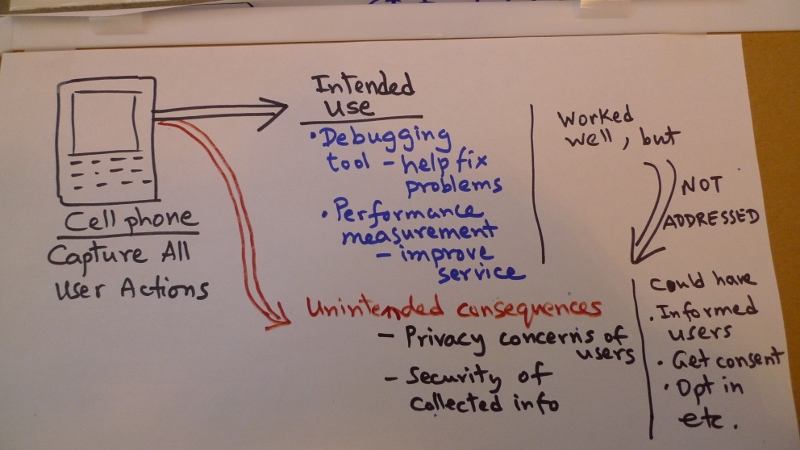
Let’s start with an example. Suppose you are a cell phone manufacturer and you decide to capture all user actions so that you can “debug” -- fix problems -- when something goes wrong and also improve performance when you see some parts of the system not performing to expectation. Capturing user actions is a perfectly valid approach to this need, but, if you did not inform the users upfront, they’d probably be concerned about privacy and security of the collected information.
As another example, suppose we promote production of ethanol from corn as a fuel and as a way to reduce dependence on fossil fuel. However, corn is also used as food and as cattle feed. What if there is impact on food prices and cattle feed because corn is diverted from these uses to ethanol production.
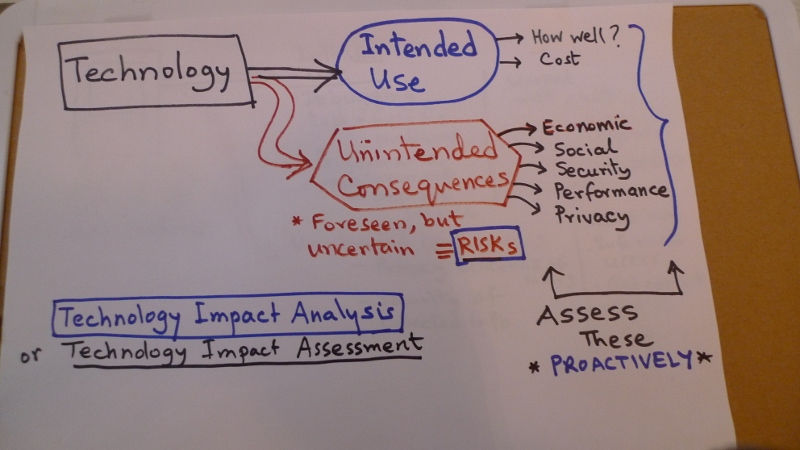
One way to avoid such problems is to conduct a technology impact analysis (or technology impact assessment) up front. The framework is fairly straightforward. You consider the technology for some intended use. Now, before you adopt the technology, think of all the unintended consequences, which are usually not good. These are foreseen, but uncertain, and, therefore, “risks.” If you think of them up front, you can then take action to either mitigate these risks or decide to accept them.
In the case of the cell phone example, if this was done, the cell phone manufacturer could have foreseen the privacy and security risks and acted beforehand by informing the users about the intended use of the information being captured and letting them opt in, if they so desired.
In summary, it’s important to assess the impact of technology before deciding to incorporate it in a product or adopting it for your or your organization’s use. Proactively doing an impact assessment could save you lots of headaches and, not to mention, potential negative consequences later on.
Here's some more information to help you...
The following book covers similar ideas and may be interesting to check out:

Sunday, November 6, 2011

Why public cloud


In previous videos I discussed what is cloud computing, why it’s important to consider as an option, and what are some of the risks.
Because of the risks, especially those relating to security and loss of control over where data resides, your organization may prefer the private cloud option, which, as I have said previously, is still a good option that provides you with the benefits of reduced number of physical machines along with lower electricity and cooling needs, as well as needing fewer staff to administer the machines.
However, unless your organization has hundreds of thousands of employees, a private cloud is not going to give you the cost savings that come from the economies of scale that public clouds enjoy.
To implement the private cloud, you’ll need upfront investment to virtualize your servers and add the software needed to operate it as a cloud. You are not going to just pay for what computing resources you need - - you basically still have to maintain the systems you need for your worst-case computing load.
Some go as far as to say that a private cloud is not a cloud at all because a cloud should have “elasticity” - - meaning you can create new virtual machines on demand and shut them down when you don’t need them. A private cloud cannot easily provide this elasticity, unless it’s for a huge number of employees.
With a public cloud, you can truly pay for computing as you go - - just buy what you need, when you need it. That’s why, unless you have hundreds of thousands of employees or information that’s very sensitive (like military information), you have to consider public clouds to get the benefits of cloud computing. If that’s not acceptable, you can consider a community cloud suitable for your organization. For example, government agencies could opt for a government community cloud where you could at least get some economies of scale.

Here's some more information to help you
Here are some books on cloud computing that you may consider:

Saturday, October 29, 2011

What are some of the risks of Cloud Computing


In other videos I explained what cloud computing is and why it’s useful. In this video, I want to mention some of the risks of cloud computing - - things that could potentially go wrong and affect your organization when you use cloud computing. Of course, if you implement a cloud in your own data center for your organization’s use, then the risks are similar to ones you already have - - security, privacy, disaster recovery, etc.

However, if you are planning to use cloud services provided by a third party, then you need to think of any new risks that may apply to your situation and that’s what I’ll cover.
First, the obvious risks - - security and privacy risks because of not knowing whether the vendor’s cloud is secure, that the staff who manages the facilities are trustworthy, that privacy protections are up to the level required by law.
Second, we have some management and oversight risks - - relating to potential lack of control in figuring out where data is stored and processed and how to get it back, if you change provider. The oversight risk is the possibility that your auditor cannot get access to the cloud provider’s systems to check them out.
Third, there are some technical risks, relating to lack of standard definitions of what a cloud service is, how are fees set, how to move data from one cloud to another, whether you can get reliable performance...
And, finally, a fourth set of risks may be relating to potential foreign laws and regulations that apply to your data because of where the cloud service is located.
Anyway, this is not an exhaustive list, but the point is that you should think what risks apply to you and then manage them, as is the prudent thing to do. Some risks already have mitigation approaches such as putting things in the contract and some have ongoing activities to help business mitigate those risks.
And, even if there is no mitigation for some, you may still decide to accept the risks and forge ahead with cloud computing. After all, that’s how we get the good things in life... by taking risks.


Here are some more things to help you...

Please see my previous post on "What is Cloud Computing" - - there I have a slide presentation on cloud computing that I used when I gave a talk in Seoul, Korea in Nov 2010 and the 30-minute video of the talk as well.

Why you should consider cloud computing as an option


You might wonder why is “cloud” a big deal. First, and foremost, if you have a collection of servers for your business, once you use virtualization, you’ll be able to support many virtual machines on a small number of physical machines - - some experts suggest that for each “core” on an Intel or AMD processor, you can have 3 to 5 virutal machines. Many servers are 4- or 6-core, so you could have anywhere from 12 to 30 virtual machines on one server, but you’d need to have lots of memory and storage as well. Nevertheless, the ability to run lots of virtual machines on a physical server means that you reduce the number of physical servers and that translates to less space, less electricity, less heat, and less messy cables, etc. So these benefits make a cloud an worthwhile proposition for businesses, even if you were to convert your current server farm to a cloud.
If you can move on to buying the cloud services from a third party, the benefits are even more. Now you can simply buy the computing power you need, without having to spend money up front. You can benefit from the economy of scale, the cloud vendor would typically have better redundant power and network connectivity that you could afford. Even security may be enhanced because the cloud provider can afford to hire more experienced information security staff and apply patches across all virtual machines more efficiently and promptly than you could.
You’d notice that I have a lot of “may” and “could” in justifying the benefits of cloud, that’s because you have to check it out for yourself to see if it meets the needs of your business. What you don’t want to do is dismiss cloud as an option because of knee-jerk reaction from others inside your organization who may bring up risks relating to security, data ownership, and many other issues as reasons why you shouldn’t go the cloud. All of these may be valid risks, but they also have equally valid solutions that mitigate the risk enough for you to take the plunge. The savings in IT costs alone make it worth taking the step to, at least consider cloud services as an option.


Here are some more things to help you...


Please see my previous post on "What is Cloud Computing" - - there I have a slide presentation on cloud computing that I used when I gave a talk in Seoul, Korea in Nov 2010 and the 30-minute video of the talk as well.


Tags: